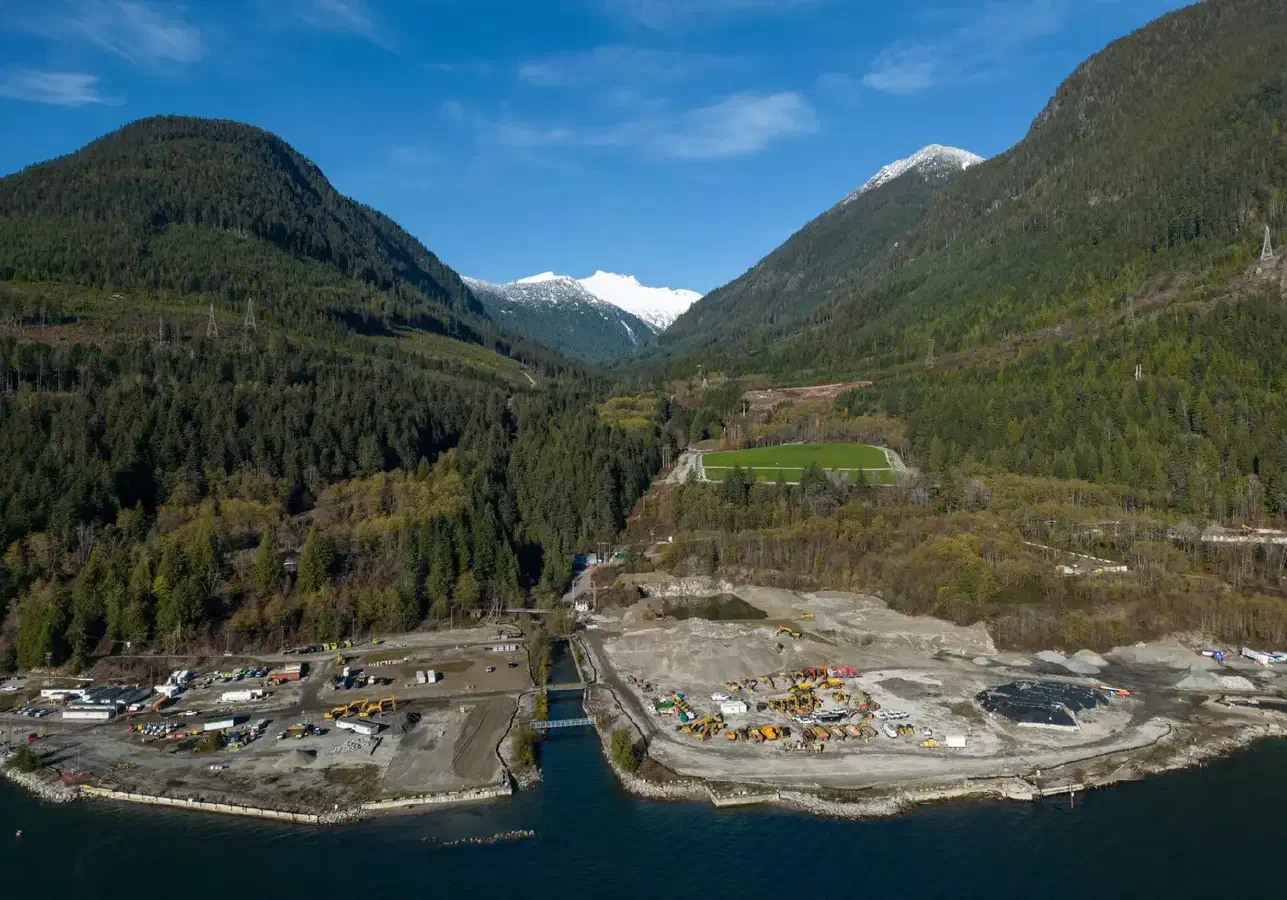
Woodfibre LNG Buildings
Key Outcomes
Automation saved 200+ engineering hours
Python tooling generated FEM-ready models for six LNG buildings in minutes instead of weeks.
30% faster than the planned budget
Delivered the foundation design package under 70% of the allotted engineering budget.
Six mission-critical buildings delivered
Kickoff to 30% design submission finished in under six weeks while coordinating all disciplines.
I played a key role in the Woodfibre LNG Buildings project - an LNG plant about 7 km southwest of Squamish, B.C., producing 2.1 million metric tonnes of LNG per year. Site access during construction and operations is limited to barge or helicopter.
My company, Brybil Projects Ltd., was contracted by LB LNG Constructors (design-builder) to design six pre-engineered buildings for the facility, EPC by McDermott. The timeline was aggressive - from project kick-off to the 30% design submission for all six buildings took under six weeks.
The buildings I contributed foundation design for:
- Administration Building
- Control and Operations Building
- Warehouse and Maintenance Building
- Chemical Storage Building
- Vehicle Shelter (formerly Garage)
- Instrument Air Compressor Building
What I did
My primary responsibility was the initial phase of structural foundation design for all six buildings. The standard workflow:
- Receive complex foundation design loads (often 2,000+ loads per structure) and load combinations (600+), typically in PDF format.
- Translate this into accurate FEM models - traditionally the most time-consuming step.
- Perform FEM analysis and iteratively refine foundation thickness and reinforcing.
- Generate and update final design drawings.
I led step 2 for every building, creating the FEM models before handing them to other structural engineers for analysis and detailing. I got this responsibility because of my track record with automation.
To handle the volume and the schedule, I built a Python application that:
- Parses foundation design loads and load combinations directly from PDF documents.
- Automatically generates FEM models complete with structural mesh, load cases, load combinations, and support conditions.
This turned what was traditionally weeks of manual work into minutes per building.
Results
- Met the deadlines: The automated workflow was a major factor in delivering all six building foundations on time, including the six-week initial 30% design submission.
- Under budget: The structural design phase came in under 70% of the planned budget.
- Accuracy: Automating the data input and model generation cut out manual error. No mistakes or rework.
- Team productivity: Freed the rest of the team from manual FEM model creation so they could focus on analysis, optimization, and detailing.
My FEM models provided the starting point for the subsequent detailed design, construction support (RFI responses, shop drawing reviews), and post-construction phases. The primary structural deliverable was raft slab foundations for all six buildings.