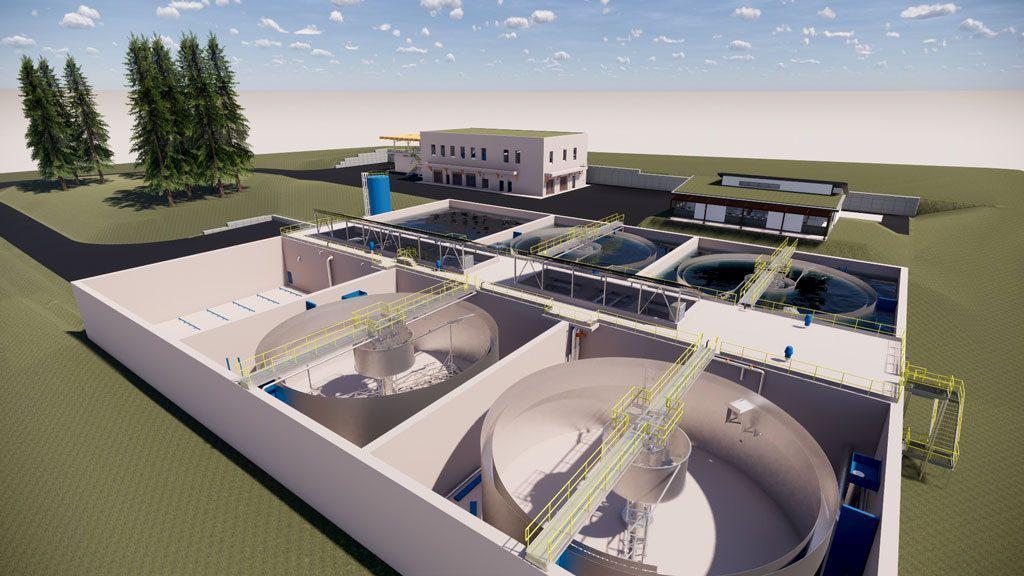
Powell River Wastewater Treatment Plant
- Project type: Consolidated Wastewater Treatment Plant
- Location: Powell River, BC
- My role: Structural Designer
The Powell River WWTP has two main structures: an administration building and a process building. I designed structural elements in concrete, masonry, steel, and wood-frame construction. A prominent feature is a structure with a raft slab foundation supporting a two-storey concrete building, a structural steel roof, and a wood-framed canopy designed for a future green roof.
The structural design had to meet the specialized requirements of a wastewater treatment facility: durability against aggressive process environments, process and operational needs, post-disaster seismic resistance, and water-tightness of process cells and channels.
What I did
Analysis and code compliance
- Performed dead load take-offs and calculated live loads, snow accumulations, wind pressures, and seismic forces per BCBC Part 4 and Appendix C Climatic Data.
- Used Dlubal RFEM for finite element modeling and analysis of the concrete superstructure and shallow raft foundations.
- Applied design loads including a bail-out force with R_d R_o = 1.3 for the steel roof and elastic seismic force with R_d R_o = 1.0 for the foundation design.
Seismic design for post-disaster performance
- Designated the concrete shear walls within the modular building components as the primary energy-dissipating elements during seismic events.
- Ensured capacity protection for all other structural members and the foundation system so the plant stays functional post-earthquake.
Connections and material specification
- Designed connections including post-installed concrete anchors, slotted steel connections, and self-tapping screws to accommodate construction tolerances.
- Engineered heavy timber connections with a focus on mitigating moisture ingress - critical for durability in the marine environment.
- Specified high-performance coating systems for all structural steel for corrosion protection.
Wastewater facility requirements
- Designed to the specific demands of wastewater treatment: process integrity, water-tightness, and durability against aggressive operational environments.
Quality assurance and peer review
- Design phase: Reviewed designs with the supervising engineer. Submitted designs and calculations for independent third-party review by a senior engineer per the company’s OQM program. Incorporated all review comments, revised drawings, and did a final personal review before issuing for construction. Applied this process to all structural components.
- Construction phase: Reviewed shop drawings for compliance. Conducted frequent field reviews of concrete reinforcement, steel connections, and wood connections. Documented site deficiencies in field review reports and followed up with the contractor. Reviewed concrete test reports to confirm materials met design standards.
Results
- Delivered a structural design meeting all project requirements, performance specs, and post-disaster criteria.
- Designed the gravity and lateral force-resisting systems as integrated systems.
- The Powell River Consolidated Wastewater Treatment Plant was successfully constructed by September 2022.
Understanding of structural systems
To illustrate how I approach individual components as part of integrated systems, here’s an example from a lightweight timber office building I designed. The engineering principles are the same ones I applied to the more complex Powell River WWTP.
Gravity system:
- Load analysis at each level, then designed roof joists and floor joists.
- Sized beams and headers for openings from architectural drawings.
- Designed posts and built-up studs for point loads from beams and headers.
- Accounted for cumulative gravity loads at the foundation and checked perpendicular-to-grain bearing at all support points.
Lateral system:
- Determined base shear demands and designed horizontal diaphragms to resist and distribute seismic forces at each floor.
- Checked shear capacity of diaphragm sheathing and nailing patterns.
- Sized chord and strut members for axial forces in the diaphragms.
- Designed connectors for shear transfer from diaphragms to shear walls.
- Verified shear wall sheathing and nailing capacity against cumulative shear forces.
- Detailed interstorey fasteners and sill plate anchors for lateral load transfer to the foundation.
- Designed hold-down systems for overturning resistance in shear walls.
Project management
On the Powell River WWTP, where our firm was structural engineer of record for two concrete buildings and one light-frame timber structure, I actively assisted the Project Manager.
- Participated in regular coordination meetings with the architect and MEP consultants. I raised outstanding items and flagged potential bottlenecks. Prepared scope change forms as needed.
- Construction phase:
- Attended weekly construction meetings, addressing site issues and updating on RFI and shop drawing review status.
- Prioritized prompt return of submittals, especially for critical path items.
- Organized separate teleconference calls with project team members for complex or persistent issues.
- Kept the Project Manager informed of project changes and gave early warning if the timeline was at risk. Tracked hours and provided estimates to completion.
- Attended weekly meetings with the client and contractor to stay current on the construction schedule.
- Collaborated with the architect, electrical engineer, and mechanical engineer to deliver timely RFI responses, shop drawing reviews, and field review feedback.
- Issued site instructions for unforeseen field conditions and reviewed contract change requests, advising the client on validity.
- Identified and addressed on-site deficiencies before project sign-off.