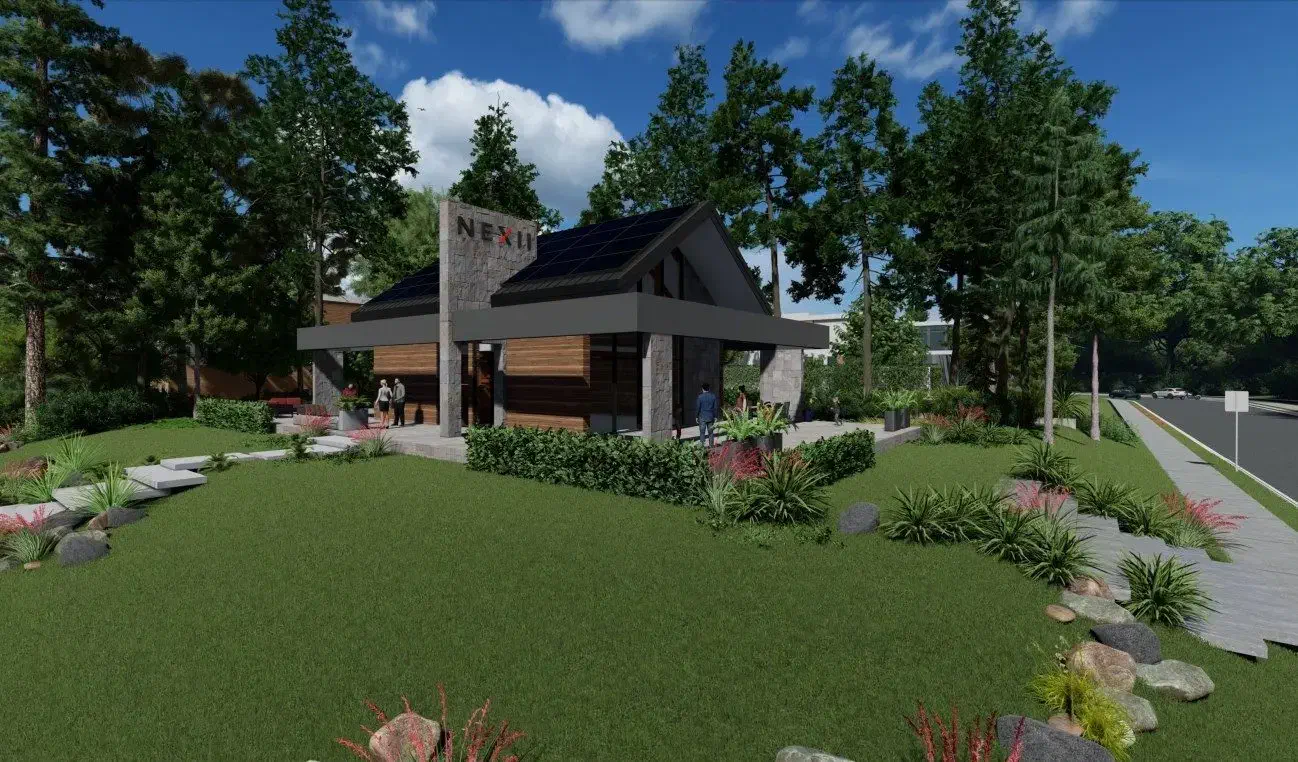
Paradise Show House
This project was the structural design for a primary residence and a separate garage/office in Paradise, California. The main residence had shallow footing foundations, a structured ground floor over a crawl space, a partial second floor, and a pitched roof. The superstructure used steel beams supporting Nexii panels for the ground and second floors, with exposed timber beams supporting Nexii panels at the roof. Load-bearing Nexii panels were designed to carry floor and roof systems and resist lateral loads. The separate garage/office (~300 sq ft) had a concrete slab-on-grade, shallow foundations, and a similar Nexii superstructure.
What I did
- Designed all conventional concrete elements - foundations and retaining walls - for the Nexii single-family show home.
- Designed the concrete foundation system for the ~300 sq ft auxiliary structure.
- Reviewed Nexii’s calculations and details for their proprietary panel system. Initiated discussions to clarify design parameters and resolve ambiguities.
- Identified missing information about the proprietary panels and, recognizing the limits of my scope of practice, worked with my supervisor and the client to establish a clear workflow: I focused on superstructure steel and concrete foundations, while the client’s team handled the panel design and force calculations. This made sure the right expertise was applied to each part.
- Wrote technical specifications.
- Participated in project coordination and design meetings.
- Provided engineering support for permitting and construction.
Design challenges and solutions
The main challenge was integrating the proprietary structural panels as primary load-carrying members.
- Lateral bracing: Selected specific wall panels for eccentric bracing to maximize bracing length and minimize diaphragm spans. Eliminated vertical structural irregularities by stacking braced frames continuously through the building height.
- Seismic design: Designed connections and foundations for ductile behavior, with seismic loads calculated at 20% above the frame wall capacities - exceeding code requirements.
- Climate adaptation: Added a 10% increase in snow loading beyond code requirements to account for potential climate change effects.
- Diaphragm analysis: Checked diaphragm chords for axial forces (not just shear against diaphragm capacities) and analyzed stress concentrations at openings and cantilevers.
- Capacity hierarchy: Designed so primary members always have higher capacity than connecting secondary members (Foundation > Column > Girder > Beam), creating a predictable failure hierarchy.
Status
The structural design is substantially complete. The project is paused pending resolution of overseas local code requirements.