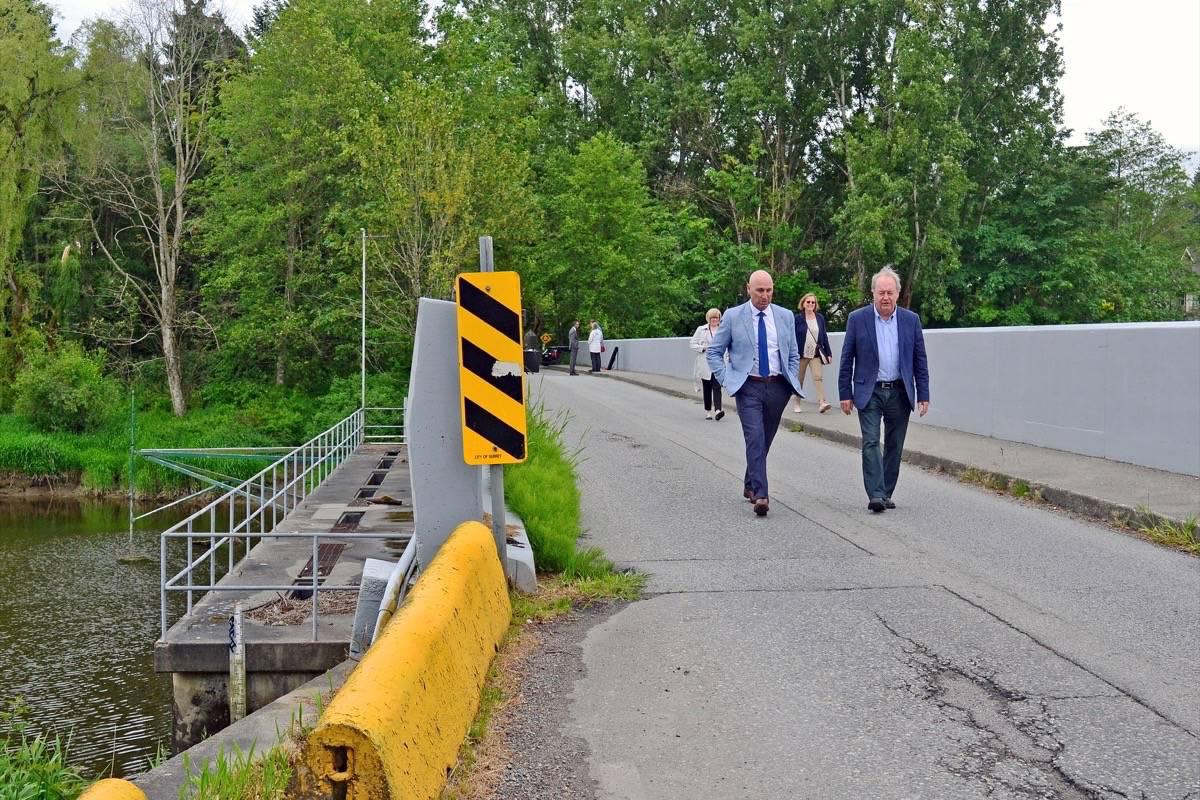
Nicomekl Sea Dam Replacement
Key Outcomes
Protects 5,000+ hectares of Surrey lowlands
Helped reimagine the sea dam to deliver long-term flood protection under the Coastal Flood Adaptation Strategy.
Seven-channel gravity + pump-ready WCS
Developed conceptual and preliminary designs for 3m x 4.67m flow channels and future pump integration.
Integrated pile-supported raft slab
Engineered concrete-filled steel piles and raft slab system to resist sliding, overturning, and extreme settlements.
The Nicomekl Water Control Structure (WCS) project, initiated by the City of Surrey, is part of its Coastal Flood Adaptation Strategy (CFAS). The almost century-old Nicomekl Sea Dam is vulnerable to projected sea level rise and seismic events and needs replacing. The new WCS provides flood protection for Surrey’s lowlands - agricultural areas and infrastructure.
The new structure sits upstream of the existing sea dam, adjacent to King George Blvd. The project also includes relocating existing Metro Vancouver and City of Surrey water mains.
My role
As a Structural EIT, I worked from the initial project phases through to detailed preliminary design.
Project initiation and conceptual design
- Reviewed the Request for Proposal (RFP) to understand scope and client objectives.
- Collaborated with the project manager to develop a proposal addressing all RFP requirements.
- Drafted responses to RFP requirements.
- After contract award, executed the work plan and led the creation and refinement of conceptual designs for the WCS, which I presented to the client for review.
Preliminary structural design
- Designed the overall WCS structure in reinforced concrete with C-1 exposure class for coastal conditions (seawater spray, freeze-thaw cycles).
- Developed the structural configuration for seven gravity flow channels (each 3m wide x 4.67m high), designed to accommodate future hydraulic pumps.
- Designed the concrete base slab as a continuous pile cap connecting supporting piles and serving as the floor for tunnels and approach wing walls.
- Designed the tunnel roof slabs (discharge slabs), suspended from channel walls, to protect water mains and conduits while supporting a multi-use pathway and occasional maintenance vehicles.
Foundation system
- Contributed to the design of concrete-filled steel piles (610 mm diameter) extending to hard stratum for end-bearing support.
- Designed the pile-supported raft slab for stability against sliding and overturning.
- Collaborated on preliminary pile design calculations, assessing axial capacities in compression and tension, and developing P-Y curves for the detailed design phase.
Specialized components
- Designed the downstream slab above discharge level for future pumps, with knock-out panels for installation.
- Detailed extended channel walls on the upstream side for future debris screens, trash rakes, and conveyor belts.
- Designed a 5m removable hatch in the roof slab for maintenance access to city utility pipes and the Metro Vancouver water main.
- Incorporated openings in the north abutment wall for fish passage gates.
- Designed support channels cast into concrete dividing walls for stop logs in each tunnel bay.
Gate system integration
- Designed for side-wall hinged gravity gates on the ocean side and stop logs on the riverside.
- Analyzed and adapted structural supports for different gate supply options, including reuse of existing gates.
- Designed structural support for two fish slots (300mm wide x 500mm and 1000mm tall) and their weir gates, designed for a differential head of up to 3m.
Access and dyke integration
- Designed access hatches (e.g., 5m x 3m central equipment access hatch) and manholes within the pavement slab for inspection and maintenance.
- Ensured the structural tie-in of the WCS with extended dykes on both sides of the Nicomekl River.
- Addressed potential differential settlements between the on-grade dyke fill and the pile-supported WCS.
Engineering challenges
Geotechnical conditions: Variable soils - silty sand to clayey silt/silty clay over very stiff glacial till at varying depths. The end-bearing concrete-filled steel pile design addressed this. I analyzed the impact of variable pile capacities due to dipping glacial till and contributed to strategies for managing estimated settlements (up to ~140 mm north, ~230 mm south), including preloading, surcharge treatment, or increased dyke height.
Construction staging: Full-width river construction required a phased approach within dewatered zones. I worked through the implications of coffer dam designs supporting ~5.7m of water, including challenging sheet pile installations into dense till. Contributed to the idea of using a lower concrete working slab placed by tremie method as the lower brace to optimize the work zone.
Durability: Specified C-1 exposure class concrete for the coastal environment. Participated in evaluating gate material options, supporting the recommendation for stainless steel due to superior long-term performance in corrosive conditions.
Utility integration: The WCS accommodates two major water mains (City of Surrey 300 mm DI and Metro Vancouver 750/1,050 mm STL), including a water main casing with flexible sleeve connections to protect dyke integrity. I also integrated provisions for future pumps, debris screens, and fish passage into the structural design.
Highlights
- Structural design contributing to a flood defense upgrade for Surrey’s lowlands against sea-level rise and seismic events.
- Fish passage features including two dedicated fish slots and weir gates.
- Multi-use pathway and amenities integrated into the structure.
- Designs accommodate future hydraulic pumps and debris removal systems.
- C-1 concrete and careful foundation design for long service life.