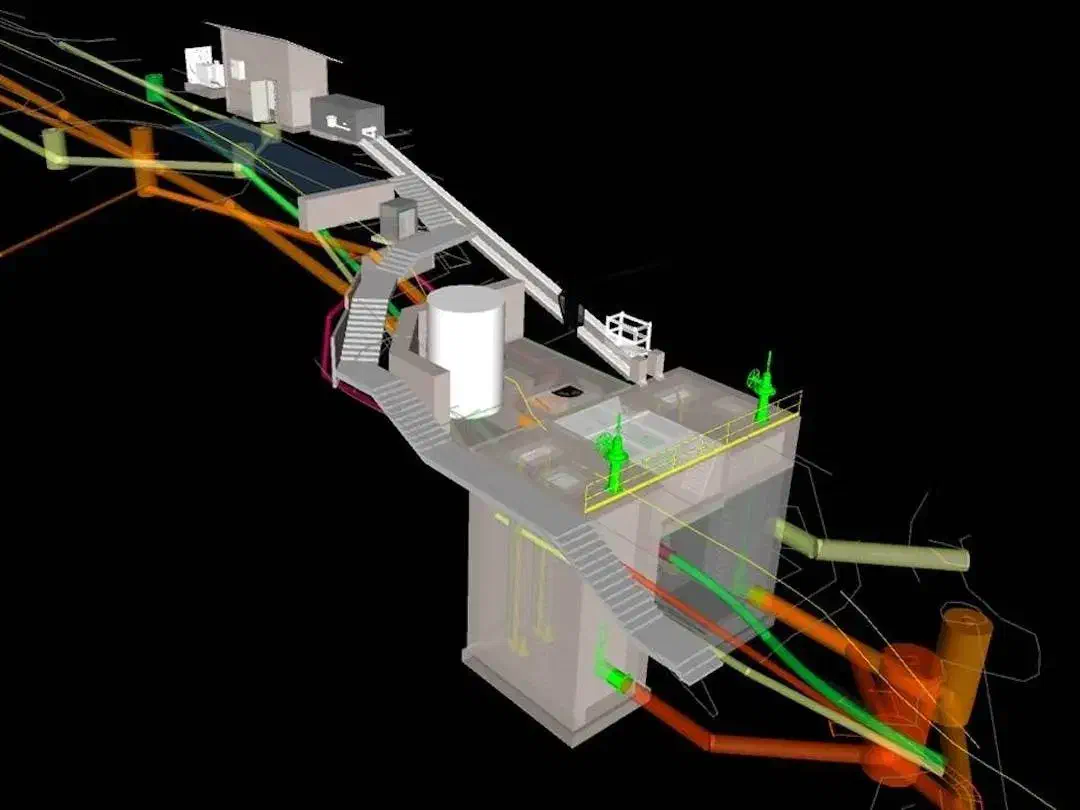
Bay Avenue Wastewater Pump Station
This project was a redesign and structural upgrade of the Bay Avenue Wastewater Pump Station, a 300 L/s facility on a tightly constrained site. The site had steep excavations requiring temporary shoring. I designed a new valve chamber and second wet well integrated with the existing concrete wet well, engineered strengthening details to bring the existing wet well up to current seismic and operational codes, and detailed a guide track system for a material conveyance cart.
My role
I was the structural designer, responsible for structural analysis, design, and construction documentation for the new concrete wet well structures and an adjacent Motor Control Center (MCC) building.
What I did
Structural design:
- Designed a new partially buried concrete wet well and valve chamber, integrated with existing infrastructure.
- Developed strengthening and retrofitting schemes for the existing wet well to meet current codes.
- Completed the structural design for a new one-storey concrete MCC building with a metal deck roof on steel beams.
- Detailed the guide track system for the material conveyance cart.
Analysis and modelling:
- Calculated dead loads, superimposed dead loads, live loads, snow loads, wind pressures, and seismic forces per BCBC Part 4 and NBCC Structural Commentaries.
- Worked with the geotechnical engineer to get site-specific soil parameters - site coefficients, lateral soil pressures, modulus of subgrade reactions - into the structural models.
- Coordinated with process mechanical teams to define design water levels and hydrostatic loading conditions for the wet well.
- Calculated hydrodynamic forces within the wet well using ACI-350.3 (Seismic Design of Liquid-Containing Concrete Structures).
- Built a finite element model in Dlubal RFEM to identify stress and strain concentrations and optimize the design.
- Cross-checked FEA results against hand calculations at critical locations.
- Verified an existing underground concrete valve chamber where original design loads were undocumented. I integrated operational loads (from Process Engineers) and BCBC requirements into a structural model, validated it against hand calculations, and calculated base slab capacities from record drawings. The chamber turned out to be adequate for the new design demands.
Component design:
- Designed all reinforced concrete components per CSA A23.3 and ACI-350.3.
- Designed the MCC building’s steel roof beams in Tedds per CSA S16.
- Used S-Concrete for the MCC building’s concrete wall design per CSA A23.3.
Documentation and communication:
- Translated designs into detailed engineering drawings.
- Reviewed final drawings and specs for accuracy and completeness.
- Wrote a technical memo on the existing valve chamber analysis - methodology, assumptions, support conditions, results in table format. After review by my supervisor and the Project Manager, it was submitted to the client. The memo confirmed the chamber’s structural adequacy, saving the client from costly reinforcement or replacement.
- Prepared and issued the structural package for Building Permit.
Outcome
The structural drawings and specifications were issued for tender, and the construction contract was awarded. The project is currently under construction with projected completion in 2023. description: “Validated existing valve chamber capacity and engineered RC components to CSA A23.3/ACI-350.3 - avoiding an estimated $300k replacement.”